


For years, we cared for children who, due to chronic health conditions, depended on technology to survive.
Even when clinically stable, they remained in the hospital for long periods of time. This was because their families did not feel prepared to continue providing care at home. In some cases, a lack of preparation could even put the child at risk.
In 2012, Hospital Martagão Gesteira decided to redesign this journey. That is how HOME FIRST was born — a family-centered model of care. The journey was mapped across five stages, connecting the hospital, the home and the community. An evolution beyond continuous professional home care.
At the HOME FIRST Discharge Training Unit, family members learn, practice and build confidence to take on their child’s care.
When the family feels ready, care continues at home, supported by a multidisciplinary team. When the journey changes, the results follow.
Not only in the numbers. But in the lives of children and their families.
The Problem: When Hospitals Become Permanent Homes
Children dependent on life-sustaining technology — mechanical ventilation, tracheostomy, spinal muscular atrophy — were living inside hospitals, some in ICUs for over six years. Their mothers lived there too. Healthcare systems were never designed for what comes next.
The Paradox
Children remain hospitalized for months or years — not because they require acute treatment, but because the obvious answer (professional home care) is economically unviable at scale for public systems and cannot reach the favelas where many families live.
For Children
Developmental delays, reduced social interaction, increased exposure to hospital-acquired infections, loss of family life and childhood milestones. Institutionalization compounds clinical complexity.
For Families
Parents abandon employment, experience severe psychological distress, and develop chronic anxiety — becoming permanent hospital residents instead of caregivers. Families are suspended between two worlds.
For Health Systems
ICU beds occupied by clinically stable patients; other critically ill children wait for access; resources consumed without corresponding health
gains. System-wide inefficiency compounds individual suffering.
The Real Barrier Is Not Clinical
It Is Systemic and Social: Professional home care is economically unviable at scale. HOME FIRST inverted the logic: it transfers clinical skill to families through immersive training and competency-based discharge, so safety no longer depends on a professional’s presence. It also required a new institutional care protocol, formally approved by the hospital, authorizing ventilated children to live at home.
The Service Journey: 6 Interconnected Stages
HOME FIRST is organized as a seamless, end-to-end service journey — not a sequence of isolated clinical interventions. Each stage is intentionally designed to reduce uncertainty and build caregiver confidence, spanning from hospital stabilization to longterm community reintegration.
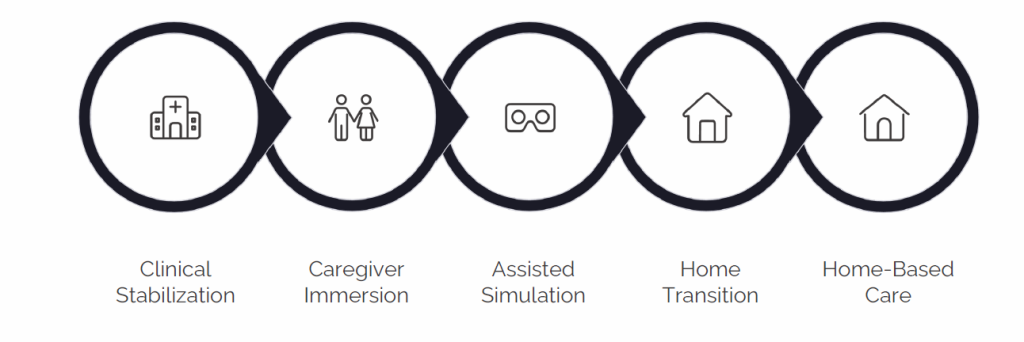
The journey moves from hospital-based clinical stabilization through immersive family training, into a carefully managed home transition backed by social infrastructure, and culminates in long-term empowerment where families become autonomous caregivers.
Measured Impact: 12+ Years of Evidence
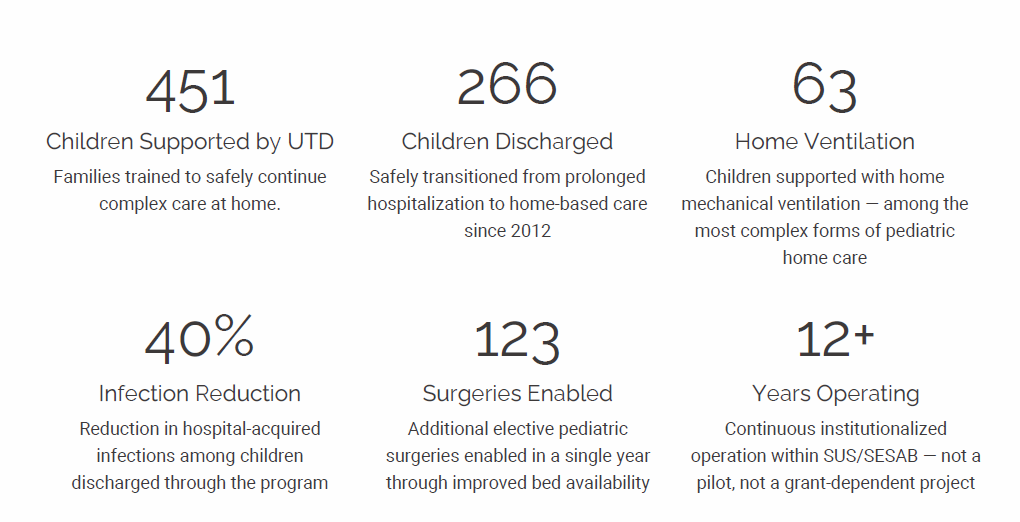
Since 2012, HOME FIRST has generated measurable outcomes across four dimensions — children, families, healthcare professionals, and the hospital system. The model runs inside existing hospital infrastructure and public funding (SUS/SESAB), requiring no new technology. It replaces continuous professional home care — costlier and territorially unfeasible — with trained family competence, backed by weekly visits and reserved ICU beds.
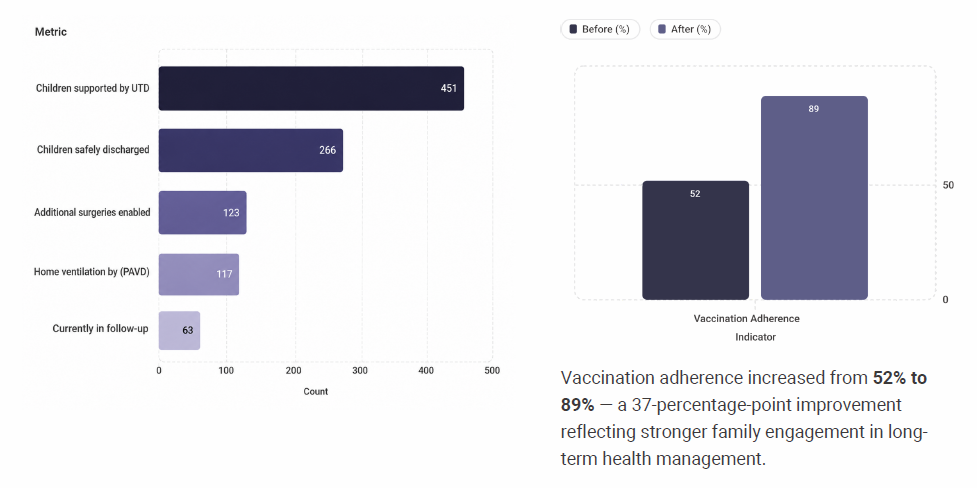
The ICU beds released by HOME FIRST enabled 123 additional elective pediatric surgeries in a single year — demonstrating that dehospitalization benefits the entire pediatric healthcare network, not only the families it directly serves. Caregiver well-being also showed substantial reductions in anxiety and depressive symptoms, documented through internal program evaluations.
Read more
Content regarding the Home First (UTD) project
UTD do Martagão Gesteira já tratou de 120 crianças com doenças crônicas
Programa de assistência do Martagão permite que crianças com doenças crônicas retornem para casa
Após treinamento de mães no Martagão, crianças com doenças crônicas voltaram para casa
Academic publications
Transver o mundo: o universo particular da criança no contexto hospitalar
More videos
Watch videos produced by Martagão about the work carried ohe UTD.